
12 September 2026 · Patios and Paths
How to clean a block paving driveway after winter
Winter is hard on block paving. By March or April, most driveways across Lincolnshire are carrying a season's worth of moss, algae, traffic grime and salt residue — and the jointing sand that holds everything together has often washed away too. Knowing how to clean a block paving driveway after winter properly means tackling all of that in the right order, not just blasting it with a pressure washer and hoping for the best.
Do it right and the driveway can look close to new. Do it wrong and you'll strip the jointing sand, loosen the blocks and create exactly the weedy, uneven surface you were trying to fix.
Why block paving suffers more in winter
Block paving has gaps. Those gaps collect organic debris — leaves, soil, seeds — all winter long, and the constant damp gives moss and algae exactly the conditions they love. Freeze-thaw cycles can also shift blocks slightly, creating low spots where water sits. By spring, you've often got a green, stained surface with sunken patches and gaps that are crying out for weeds.
Areas like North Hykeham, Branston and Heighington tend to see heavy moss growth because tree cover and close-together housing keeps driveways in shade for much of the day.
What you'll need before you start
Whether you're doing this yourself or calling someone in, these are the tools and materials involved:
- A stiff-bristled brush or mechanical sweeper
- A pressure washer (1,500–2,500 PSI for most block paving)
- A rotary surface cleaner attachment (much better than a lance for even results)
- A patio or driveway-specific moss and algae treatment
- Kiln-dried jointing sand
- A leaf blower or stiff brush for the final sweep
If you don't have a surface cleaner attachment, hire one. Cleaning with just a lance leaves tiger-stripe marks across the blocks.
Step 1: clear and pre-treat the surface
Remove any pots, bins or furniture first. Then sweep the whole driveway to get rid of loose debris, leaves and any gravel that's crept onto the paving.
Once it's clear, apply a moss and algae treatment and leave it to dwell. Read the label — most need at least 20–30 minutes, sometimes longer. This kills the growth and makes it far easier to remove rather than just shifting it around with water.
Dealing with oil stains
Winter tends to leave a legacy of oil and fuel spots, especially near where a car parks. Treat these separately with a degreaser before pressure washing. Apply, agitate with a brush, leave to soak, then rinse. Trying to blast oil off with water alone rarely works and spreads the stain.
Step 2: pressure wash in the right direction
This is where most DIY jobs go wrong. Always work with the run-off, not against it — typically away from the house, toward the street. Use a rotary surface cleaner at a steady walking pace, overlapping each pass slightly.
Keep the washer moving. Holding it still for even a few seconds concentrates too much pressure in one spot and strips the jointing sand.
For tight edges and awkward corners, switch to a 25-degree fan lance rather than a pencil jet. Be especially careful near any mortar or pointing — old pointing can be fragile after a winter of freezing and thawing.
How to clean a block paving driveway after winter without losing all the sand
You will lose some jointing sand — that's unavoidable. The key is not to lose more than necessary. A surface cleaner causes far less disruption than a lance. Work at a lower pressure (around 1,500 PSI) if the paving is older or the jointing looks thin. You'll top up the sand at the end anyway, but the less you strip out, the more stable the surface stays during cleaning.
Step 3: treat any remaining stains
Once the surface has dried (or at least stopped draining), inspect for anything the pressure wash didn't shift. Stubborn black spot, iron staining or deeply embedded oil may need a second application of the appropriate cleaner. For black spot specifically, a dedicated fungicidal cleaner works better than a general-purpose one — see our driveway cleaning guides for more detail on tackling specific stains.
Step 4: re-sand the joints
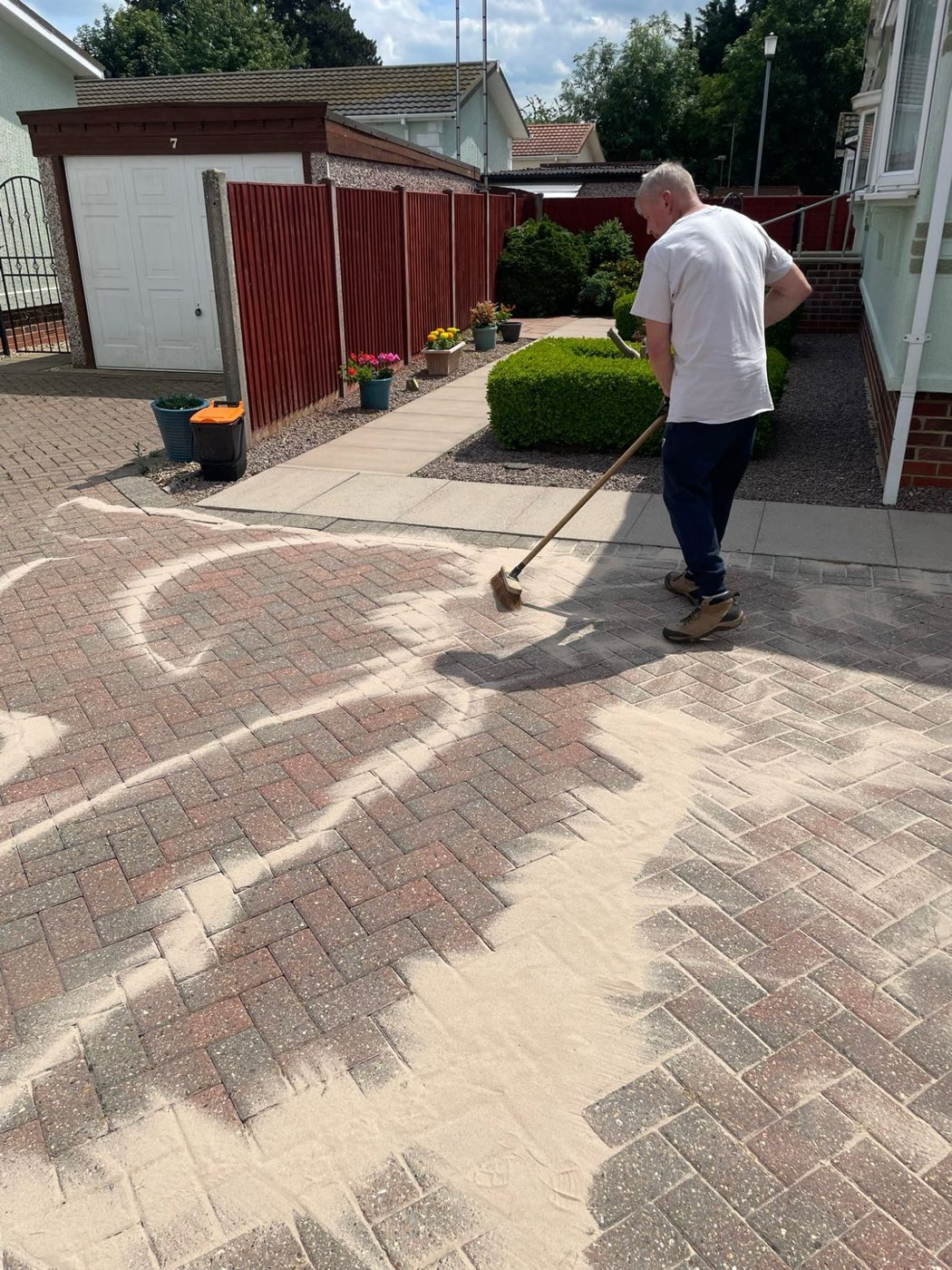
This step is critical and often skipped. Once the paving is fully dry — usually 24–48 hours after washing, longer in spring weather — brush kiln-dried jointing sand across the whole surface with a stiff brush, working it into every joint. Do this in dry conditions; wet sand clumps and won't settle properly.
Repeat the process once or twice until the joints look full and level. A plate compactor (hired cheaply from most tool hire shops) beds the sand in more effectively than brushing alone.
Full joints are what hold block paving rigid and keep weeds from getting a foothold.
Step 5: consider sealing
Once clean and re-sanded, block paving sealer is worth considering — it slows re-contamination, makes future cleaning easier and stabilises the jointing sand. It's an optional step but one that makes a real difference to how long the results last. We cover this in more detail across our patio and driveway services.
When to call a professional
If the driveway is large, heavily stained or the blocks have started to sink or rock, it's usually worth getting a professional in. We work across Lincolnshire — from Cherry Willingham and Nettleham to Skellingthorpe and Welton — and a professional clean, re-sand and treat will typically last two to three times longer than a DIY job, especially when a sealer is applied afterwards.
Ready to get your driveway looking its best before summer? Get a free quote today — no obligation, just a straight answer on what's involved and what it'll cost.
Frequently asked questions
Can I clean block paving with just a pressure washer, no chemicals?
You can, but you'll get much better results if you pre-treat with a moss and algae killer first. Pressure alone shifts loose debris but doesn't kill the growth, so moss and algae come back faster.
How long does it take for block paving to dry after pressure washing?
In decent spring or summer weather, most block paving is dry enough to re-sand within 24–48 hours. Cold or overcast conditions can stretch that to 72 hours or more — don't rush it, or the sand won't settle properly.
Will pressure washing remove the jointing sand from my block paving?
Some sand loss is normal, which is why re-sanding is part of a proper clean. Using a rotary surface cleaner rather than a lance, and keeping the pressure below 2,000 PSI, minimises how much sand you strip out.
How often should I clean my block paving driveway?
For most Lincolnshire driveways, a thorough clean once a year — ideally in spring after winter — is enough to stay on top of moss, staining and sand loss. Sealing afterwards can extend this to every 18–24 months.
Need a hand with yours? We cover Lincolnshire for patios, driveways, paths and more — see the areas we cover or browse our services. Get a free quote or call 07874 010739.
Keep reading
More on driveway cleaning
How to clean a resin driveway without causing damage
Resin driveways look stunning when clean — here's exactly how to keep yours that way without lifting the surface or voiding your warranty.
How to clean a driveway after heavy rain
Heavy rain leaves driveways muddy, stained and slippery — here's exactly how to clean yours back to a smart finish.
How to clean a driveway edging and border properly
Weedy, mossy joints can ruin an otherwise tidy driveway — here's how to clean block paving joints properly and stop the problem coming back.